And the Idea Left the Hand
“He worked at the bidding of some designer outside his craft, who … cared nought for the material his hands were not to deal with, or the finished wares he might never see.”
The Medici were buying their place in paradise; Bracciolini and Niccoli were drawing the manuscripts of Lucretius and Cicero back out of oblivion; and day after day people looked up at the invisible dome of Santa Maria del Fiore. The year is 1418, and we are in Florence. For more than half a century the cathedral had carried the promise of a dome that no one yet knew how to build. The model associated with Neri di Fioravanti had fixed its form: a vertiginous octagon, forty-five metres across, with no external buttresses. What remained was the problem of raising it. A vault had to be shaped over a temporary timber centring until, once closed, it held of its own accord. But no known centring could span such a width. So the Opera del Duomo, under the authority of the Arte della Lana, the powerful guild of wool merchants, opened a competition and promised two hundred florins to whoever found the method.
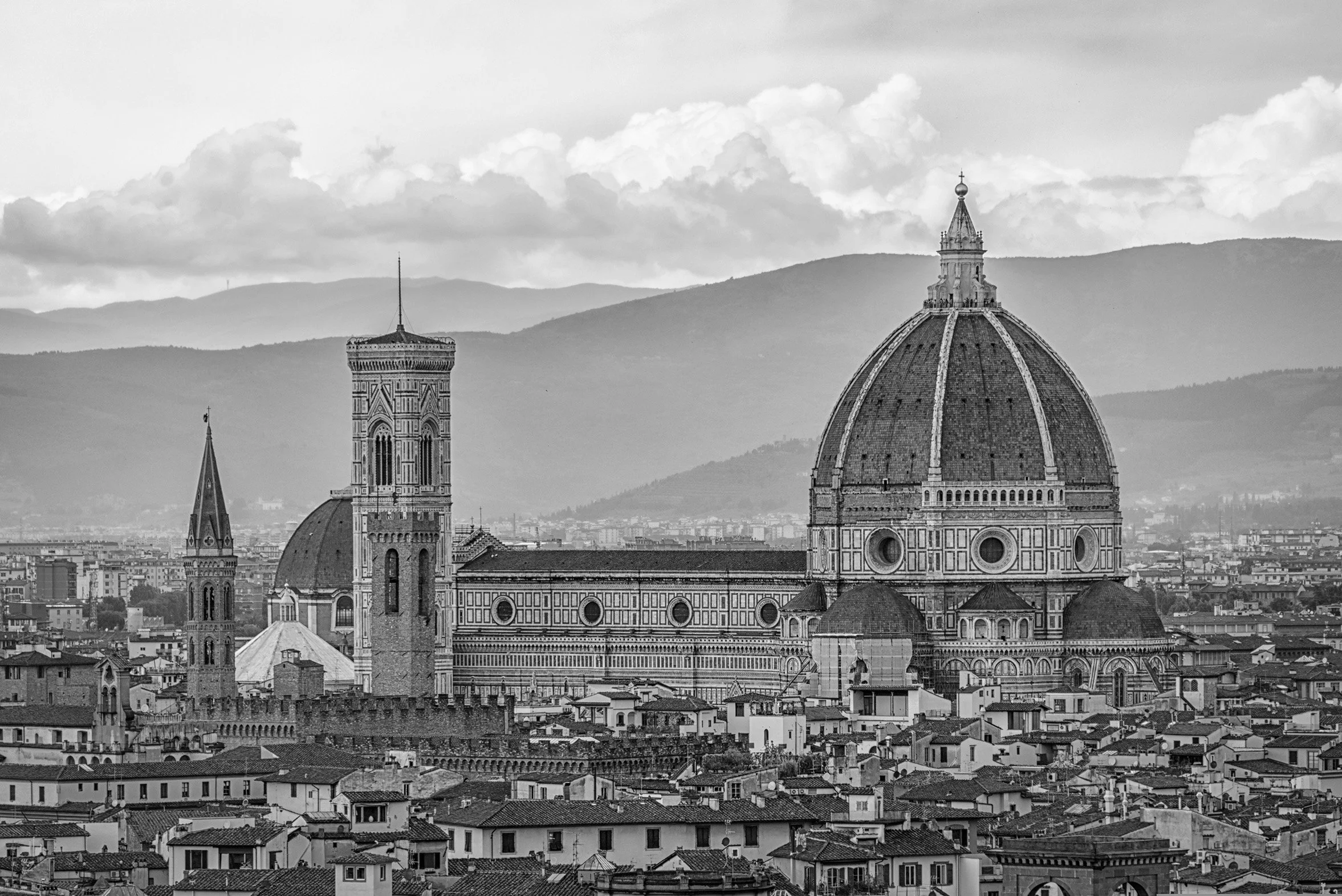
Santa Maria del Fiore
A goldsmith and sculptor, Filippo Brunelleschi offered to vault what the master masons judged impossible. The man had never raised a building; he had turned to architecture after the competition of 1401–1402 for the doors of the Florentine Baptistery, a commission that went in the end to Lorenzo Ghiberti. Brunelleschi put forward a scheme capable of doing without load-bearing centring. His model, built up in brick and mortar, with measurements and calculations, was precise enough to convince the Opera. But Brunelleschi stayed guarded about the method, for he meant them to buy the man, not his secret.
The Opera entrusted him with the work in 1420. The institution was prudent, and would not leave the fate of so uncertain an undertaking to the hands of a single man. To share the burden and the risk, it set beside him Battista d'Antonio, master mason, and Ghiberti, who had by then spent nearly twenty years on the north doors of the Baptistery. Then one of the most prominent artists in Florence, Ghiberti embodied the acknowledged authority of the workshop and of the public commission.
What followed put that shared authority to the test. In the summer of 1423 came the moment to lay the great chain of chestnut beams that was to girdle the dome and hold it, one of the most delicate operations of the whole structure. His biographers tell that Filippo took to his bed, complaining of pains in his side. The work slowed. The carpenters, at a loss how to set the enormous timbers, came to beg him to guide them; he sent them to his colleague, since Ghiberti too was answerable for the work. Ghiberti laid a few beams. Brunelleschi, recovered, returned, examined the work, and judged it fit to be undone. He directed the repairs himself.
From 1423, a document tied to that wooden chain named him the inventor of the dome. Three years later the hierarchy became official: Brunelleschi's role was strengthened, his salary raised from thirty-six to a hundred florins a year. Ghiberti, though he remained officially on the payroll until the work was finished, played an ever less central part.
The wool merchants had believed that by giving the work more than one master they would secure its crowning. In truth, what carried the work to its end was a single mastery that held the whole of it: the understanding of conception, of method, and of making; the anticipation of every pitfall; and a presence on the site, engaged in the matter itself.
On 25 March 1436, the dome closed, the cathedral of Santa Maria del Fiore was consecrated by Pope Eugene IV. It still stands today.
Disegno
In 1436, in his treatise on painting dedicated to Brunelleschi, the scholar and architect Leon Battista Alberti saluted the dome raised without centring. By the middle of the century Alberti would write the first great architectural treatise of the Renaissance, the De re aedificatoria, and in it shift the authority of the art of building toward the mind. For him the architect becomes the one who conceives the building in thought, sets its lines, judges its proportions, orders its beauty; it is not his office to direct the work in the dust of the site. The historian Mario Carpo has put it in a clean phrase: Alberti's architect does not make buildings; he produces representations of buildings that others will have to realise.
Did Alberti see that the very thing which had made the feat of the dome of Santa Maria del Fiore possible owed as much to Brunelleschi's inventive genius as to his presence on the site, his direct engagement in the raising of it? That it had required, sustained over years and through one and the same body of men, the union of the forces of mind and of making? Perhaps not.
A century later, a word freighted with a fertile ambiguity would carry this hierarchy. A word that meant at once the intention and the drawing of it: the purpose formed in the mind, and the faculty of conceiving a form and bringing it forth in line. Disegno.
Giorgio Vasari, painter, architect, and the first historian of art, made disegno a matter of the intellect, father of the three arts born of the mind: painting, sculpture, and architecture. On 13 January 1563, Cosimo I de' Medici approved the statutes of the Accademia del Disegno, carried by Vasari and by a circle of Florentine artists and humanists.
Before that date the Florentine painter held no rank apart. He was enrolled in the guild of physicians and apothecaries, because his trade, like theirs, meant grinding and mixing powders to draw colour from them. He was a man of a craft among men of crafts. The Accademia was conceived to lift him out of it, by degrees: it gave artists a new body, more prestigious than guild membership, and came in time to take on several of the functions until then reserved to the guilds. Its reason for being was to bring artists nearer to men of letters and of science, and to grant them the intellectual dignity the guild could not confer.
To want for the artist the regard owed to his mind was just. Yet this new dignity carried a new hierarchy with it, between those who conceive and those who execute. Let it be said at once, for the story requires it: what happened in 1563 cleft nothing in a single stroke. In a thousand workshops, across all of Europe, painters still ground their colours, sculptors still knew the resistance of marble, architects had not given up the conduct of the site. But the shift of authority over the works of human hands toward the mind would soon spread across all of Europe, drawing with it the slow fracturing of the immemorial union of idea and hand.
A Slow Fracturing
In 1648, in Paris, a group of painters and sculptors, among them Charles Le Brun, obtained the founding of the Académie royale de peinture et de sculpture under the regency of Anne of Austria. They meant to free their art from the control of the guilds and to win a dignity nearer the liberal arts than the trades. What Florence had institutionalised in 1563 took, in Paris, a new form: the artist was no longer a man of a craft among others.
In the manufactories of the nineteenth century, the division of labour no longer merely separated the one who conceives from the one who executes; it fragmented execution itself. The drawing came from one office, the material from another world, the gesture from a chain of partial operations. In wallpapers, textiles, furniture, and the decorative objects made for the industrial market, ornament could settle on the material like a foreign effect: printed reliefs, imitations of volume, motifs applied with no deep accord with use or with material. The object came into the world in pieces.
In 1851 the Great Exhibition in London gave this fracturing its great theatre. The Crystal Palace gathered the products of the industrial world, and many celebrated the abundance, the speed, the prowess. But certain pieces sent reformers of taste away troubled: objects overladen, illusionistic, ill-matched to their material. John Ruskin gave the grievance its most decisive form: to separate the act of conceiving from the act of making wounded not only the object made, but the man who made it. So long as the workman had no part in the invention of what he did, he could bring to it neither judgement nor true care. The work bore the mark of it.
William Morris made it the fight of his life, and not in theory alone. He set out to understand for himself the techniques he wished to bring back to life: vegetable dyeing, weaving, printing from wood. For his wallpapers, hand-printed by Jeffrey & Co. of Islington, he had pear-wood blocks cut to his own directions. Here too, the drawing was not to remain a distant idea. It had to know the resistance of the process, the soaking of the pigment, the repetition of the gesture. So Morris tried to pass the motif back through the matter, the drawing back through the process, the idea back through the hand.
Now
Today, as in the past, there are women and men who would never entrust what they imagine to hands that know nothing of its meaning and intention. Creators and artisans for whom the union of mind and making is vital to the creation of human works, and remains, to this day, the only way to raise a dome that no one knows how to build.
-
Florence, 1418. The competition for the completion of the dome was opened by the Opera del Duomo, under the authority of the Arte della Lana, the guild of wool merchants; it promised two hundred gold florins to the author of the best scheme. The prize was announced, but in the end it went to neither contender. The form of the work had been settled as early as 1367, when the model associated with Neri di Fioravanti was preferred to that of Giovanni di Lapo Ghini: an octagonal drum without buttresses, some forty-five metres across, breaking deliberately with the Gothic of the North (see Florence Cathedral, Wikipedia). On the intellectual climate of Florence in these years: the religious patronage of the Medici, Poggio Bracciolini's rediscovery of Lucretius's De rerum natura (probably at the monastery of Fulda, in 1417; see Poggio Bracciolini), transcribed by Niccolò Niccoli and soon circulated throughout Italy. See Stephen Greenblatt, The Swerve: How the World Became Modern (2011).
Brunelleschi and Ghiberti. A goldsmith and sculptor by training, Brunelleschi had turned to architecture after losing, in 1401–1402, the competition for the bronze doors of the Baptistery, won by Lorenzo Ghiberti. For the dome he presented a model of brick and mortar with calculations, without disclosing the detail of his method; the Opera entrusted him with the work in 1420, setting beside him, at equal rank, Ghiberti and the master mason Battista d'Antonio. The episode of the chain of chestnut beams (summer 1423), Brunelleschi's illness, real or feigned, and his redoing of Ghiberti's work are recounted by his biographers. On the chronology of his recognition (a document of 1423 naming him inventor of the dome, the hierarchy made official in 1426, his salary raised from thirty-six to a hundred florins a year, and Ghiberti's position, on the payroll until the completion of 1436), see Margaret Haines, Myth and Management in the Construction of Brunelleschi's Cupola; Ross King, Brunelleschi's Dome (2000); Antonio Manetti, Vita di Filippo Brunelleschi (c. 1480); Giorgio Vasari, Vite (1550 and 1568); and, for an accessible summary of this salary chronology, National Geographic.
The dome. Octagonal, double-shelled, raised between 1420 and 1436, with an inner diameter of about 45.5 metres, it was built without the timber centring that ordinarily supported great vaults. It was the first octagonal dome of such scale raised in this way. The cathedral was consecrated on 25 March 1436, the feast of the Annunciation and the first day of the year by the Florentine calendar, by Pope Eugene IV; Guillaume Dufay's motet Nuper rosarum flores was sung for the ceremony (Opera di Santa Maria del Fiore; National Geographic).
Alberti. In Della pittura (1436), dedicated to Brunelleschi, Alberti salutes the dome raised without centring. His De re aedificatoria (written between about 1443 and 1452) shifts the authority of the art of building toward the mind: the architect conceives the building through its lineamenta: lines, angles, and proportions formed in thought, independent of matter. On the reach of this shift, and the formulation that the Albertian architect produces not buildings but representations of buildings for others to execute, see Mario Carpo, Craftsman to Draftsman: The Albertian Paradigm and the Modern Invention of Construction Drawings.
Disegno and the Accademia. Painter, architect, and author of the Vite, Vasari made disegno the father of the three arts (painting, sculpture, architecture), a faculty of the intellect before it was a line of the hand. The statutes of the Accademia e Compagnia delle Arti del Disegno were approved on 13 January 1563 in Florence, under Cosimo I de' Medici, at Vasari's instigation. Before this, Florentine painters belonged to the Arte dei Medici e Speziali, the guild of physicians and apothecaries, who supplied the pigments; the Accademia gave them a distinct body and came to assume several guild functions (a formal request to leave the guild in 1571, and incorporation as a guild in its own right in 1584; see National Gallery of Art. Another reference source places this last step in 1585, and Wikipedia in 1572 for incorporation into the guild system: historians date it differently depending on which administrative step is meant.) On disegno as both drawing and the intellectual faculty of invention, see the National Gallery, London.
A note on the history. The separation described here was a tendency, not a clean and general rupture: in the workshop practice of the Renaissance, conceiving and making long remained intertwined. See Marta Ajmar, Mechanical Disegno, RIHA Journal, 2014.
The word "design." The term comes from the Latin designare (to mark, to trace, to designate), which gives the Italian disegno, and then, by way of French, the word design. The word by which we name, today, the conceiving of objects descends in a straight line from the one that, in the sixteenth century, set the idea above the hand: the hierarchy is inscribed in the very vocabulary.
The Académie royale (1648). Founded in Paris in 1648 under the regency of Anne of Austria, the Académie royale de peinture et de sculpture arose from a petition carried by the connoisseur Martin de Charmois and presented to the council on 20 January, around a group of painters of whom Charles Le Brun would soon be the dominant figure. Its purpose was to free artists from the tutelage of the guilds and to grant them a dignity nearer the liberal arts than the trades (Larousse; L'Histoire par l'image, Réunion des musées nationaux).
The nineteenth century and the Great Exhibition. On the division of labour in the manufactories, ornament applied to the material as an added effect, and the critique of industrial taste: the Great Exhibition of 1851, held at the Crystal Palace, was celebrated as a triumph of industrial abundance but troubled many reformers, whose denunciation of "False Principles in Design" is preserved by the Victoria and Albert Museum.
Ruskin and Morris. Ruskin held that to separate conception from execution wounded the workman as much as the work. Morris first tried to print his own wallpapers on zinc plates; failing at it, he had pear-wood blocks cut (by the firm of Barrett, in Bethnal Green) and gave the hand-printing, in mineral pigments, to the firm of Jeffrey & Co. of Islington, which specialised in block-printed wallpaper (Victoria and Albert Museum; William Morris Gallery; Emery Walker's House).
Principal Works
Marta Ajmar, Mechanical Disegno.
Leon Battista Alberti, Della pittura (1436) and De re aedificatoria (c. 1443–1452).
Mario Carpo, Craftsman to Draftsman: The Albertian Paradigm and the Modern Invention of Construction Drawings.
Stephen Greenblatt, The Swerve: How the World Became Modern, 2011.
Margaret Haines, Myth and Management in the Construction of Brunelleschi's Cupola.
Ross King, Brunelleschi's Dome, 2000.
Antonio Manetti, Vita di Filippo Brunelleschi (c. 1480).
Giorgio Vasari, Le Vite de' più eccellenti pittori, scultori e architettori (1550 and 1568).